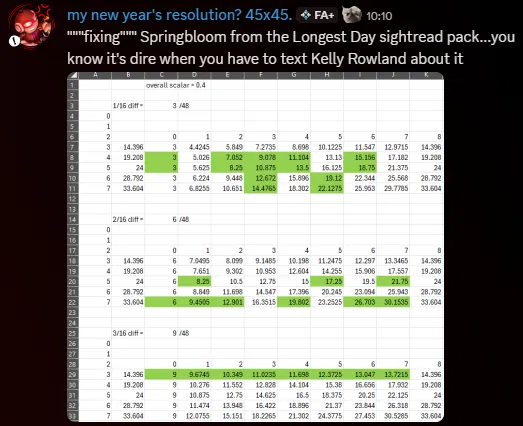
..or, a brief explanation of how the gimmick in RAID (ITL2025) works, and how Springbloom (The Longest Day 2025, ITL2026) builds on it.
Gimmicks (in the context of StepMania simfiles) historically referred to changes in vertical scrolling behavior that could be accomplished without the use of course mode or Lua to invoke play modifiers, a.k.a. “mods”. The demarcation is a little more blurry now that the #ATTACKS field is well-supported by all modern clients, and that scroll speeds have a progressive, “tweened” behavior. But you can still pull some wild tricks knowing only math and no internal play modifiers. Read about a few of them here.
Let’s start with the gimmick in RAID. By using a stop (#STOPS) event, you can halt the chart in its tracks, postponing all the future arrows. By using a scroll rate (#SCROLLS) event of 0x, you can halt the chart in its tracks without shifting its beat identity. It’s usually easier to construct color-correct halting gimmicks with scroll rates than with stops.
However, RAID appears to stop on every eighth note (red and blue), but the off 16ths (yellow) never seem to reach the targets – despite being hittable at the right time. What’s with that?
Some fundamentals:
- Scroll rates aren’t limited to positive numbers. A scroll rate of
0xwill appear to make the chart halt, and a negative scroll rate makes the chart appear to move backwards, same speed as its positive counterpart but the opposite direction. - Without modifiers, attacks, or Lua, the receptors themselves can’t be moved.
The trick in RAID is built using a combination of scroll rates and stops. Check out the scroll rates at yellow notes, and compare them to the scroll rates at red or blue notes:
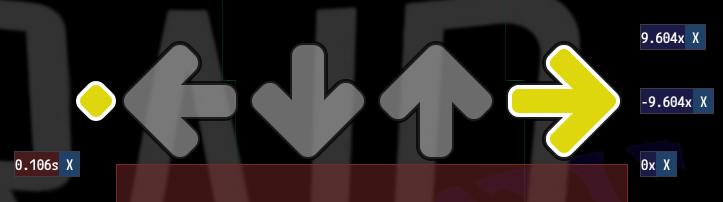
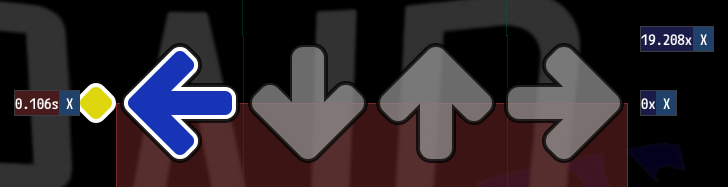
Applying a positive scroll rate for an interval prior to the yellow note, and an inverse scroll rate for an equal interval after, results in the note scrolling to meet the receptors, then back to where it was immediately after.
If we were to slow down RAID immensely, we would see the following:
We do need to spend less time on the effect at live speeds. Ideally, it should happen so fast that there’s no chance of seeing a frame mid-bounce. However, the tiniest piece of chart we can apply this on is a 192nd note at the prevailing BPM, which probably lasts for way too long (8.8ms at RAID’s BPM of 141 is longer than a 120Hz frame).
We can borrow a trick from the early 2000s here: use an extremely high BPM, then apply a stop to every note that makes up for the change in note duration, keeping everything on sync. (Since stops can only be reliably specified to 3 decimal places, there is an upper limit on the replacement BPM.)
Our plan:
- Keep video frames from catching the gimmick mid-move:
- Measure the maximum stop time by rounding down the smallest duration of interest (so we can place a scroll chunk before and after the stop). For RAID, we’re interested in bouncing over a 16th. Each 16th is (60 seconds per minute) / (141 BPM) / (4 subdivisions) = 106.383 ms, so the maximum stop length is 0.106.
- Choose a super-high BPM by treating the remainder as the full duration of interest. For RAID, I would only go as high as (60 seconds per minute) / (4 subdivisions) / (0.000383 remaining intra-note length) = ~39,200 BPM, but the file itself uses 141,000 BPM and ping-pongs between stops worth 0.106 and 0.107 to compensate. Not wrong, just different!
- Restore spacing:
- By default, the scroll rate to use for each arrow has to make one 192nd note cover the same distance as the desired duration.
- Yellow notes are 12 times longer than a 192nd, so apply one
12xscroll rate and one-12xscroll rate, before returning to0xand engaging the stop a 192nd after the note. - Red/blue notes need to cover an entire 8th, so we’d need to apply
24xprior to the note, then0xand the stop on the note itself.
- Yellow notes are 12 times longer than a 192nd, so apply one
- In practice, using the original spacing tends to be very jarring, so RAID uses
9.6x/-9.6xand19.2xto emulate 75% of default speed.
- By default, the scroll rate to use for each arrow has to make one 192nd note cover the same distance as the desired duration.
Springbloom is basically the same!
- Keep video frames from catching the gimmick mid-move: Springbloom sets a BPM of 297,500 (119 BPM gives a 16th note duration of 126.0504 ms, so I lop off the 126 ms for use in stops).
- Restore spacing: A variety of ± scroll rates (
14.4x,19.2x,24x,28.8x) show up because bounced notes need to cover 3, 4, 5, or 6 16ths. I’ve also reduced the results down to 40% of full speed, because in this case it’s important to have seven full 16ths fit comfortably on-screen at once, in the player’s focal zone. - What’s the intro doing? Without going too deeply into the math of it, I begin the chart as if I’m stopping on each note, and transition each block of seven 16ths toward the RAID gimmick gradually, so the scroll rates I choose are linear interpolations of the two gimmicks.